Methodology & Feature Extraction
This comprehensive musicology project leveraged Python and the music21 library to computationally analyze 144 solo-piano scores: 36 each by Bach, Mozart, Chopin, and Debussy. The license-safe, balanced corpus was curated from PDMX so that composer comparisons would not be distorted by unequal sample sizes, arrangements, or duplicate titles.
From every score the system derived 36 distinct mathematical features, spanning harmonic, melodic, and rhythmic structure. They include chord-quality profiles, dissonance and modal-interchange ratios, melodic range and motion, and measures such as Pitch Class Entropy and rhythmic-pattern entropy. The result is an interpretable numerical description rather than an opaque audio classifier.
Dimensionality Reduction & Statistical Analysis
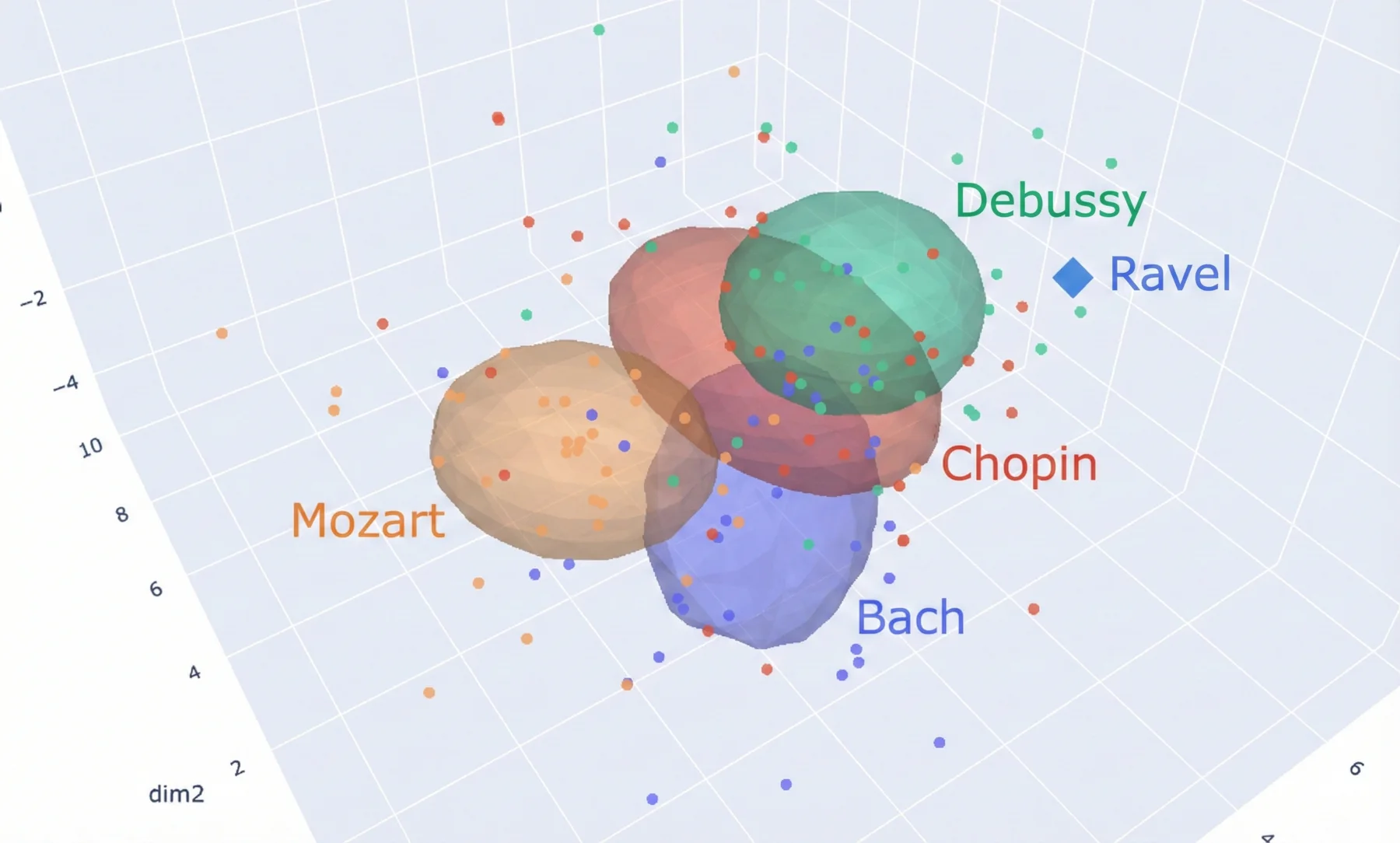
With 36 features per score the raw data inhabits a high-dimensional space impossible to visualise directly. After removing raw count-style fields, Principal Component Analysis ( PCA) was run on a standardised 144 × 30 matrix. The first three components explain 48.2% of the variance and expose composer-level structure across Bach, Mozart, Chopin, and Debussy without reducing the result to a single classification score.
One-way ANOVAwas applied to all 36 features, followed by Benjamini–Hochberg false-discovery-rate control and Tukey HSD pairwise comparisons. Twenty-nine features remained significant after FDR correction. As an external test, Ravel's String Quartet in F major was projected beyond the Debussy cluster, providing a concrete case study of the learned stylistic direction.
Key Highlights
- Curated a balanced, license-safe corpus of 144 solo-piano scores: 36 each by Bach, Mozart, Chopin, and Debussy
- Engineered 36 interpretable harmonic, melodic, and rhythmic features with Python and music21
- Found 29 of 36 features significant after Benjamini–Hochberg false-discovery-rate correction
- Applied Tukey HSD and PCA to compare composer groups and visualize stylistic structure
- Projected an unseen Ravel work as an external test case beyond the Debussy cluster
- Reached the 2026 Jugend forscht Bundesfinale and received the Preis für eine außergewöhnliche mathematische Arbeit